
Change doesn’t happen overnight. When we make a change in our lives, there are 5 stages or categories that we fall under at any given time. For change to happen in eating disorder recovery, it does not matter if the child or youth wants to change – the parents just need to want it for them.
Watch The Video Here
Unlike many changes in someone’s life, medical interventions for an eating disorder may not be a choice for some. What we mean by this is that usually a person has time to decide for themselves that it is time to make a change. When a child or youth is living with an eating disorder, this change may have to be chosen for them. Rest assured that studies have shown that readiness for change in the beginning of eating disorder treatment in youth is not necessary for successful treatment.
Stages of Change With Eating Disorders
Recovery from an eating disorder requires a great deal of change. When we talk about the stages of change, it is important to keep in mind that it is a cycle or a process, not a linear line. People move through the stages freely, and progression and regression are both expected. That is, folx can move from one stage backwards and forwards, and someone’s stage of change can change from one day to the next.
The stages of change help explain what your child may be thinking and feeling about change, not if change is possible. It is also expected that a parents’ stage of change is different than their child’s. Typically, a parent is ‘further along’ the change process than their child who is living with an eating disorder.
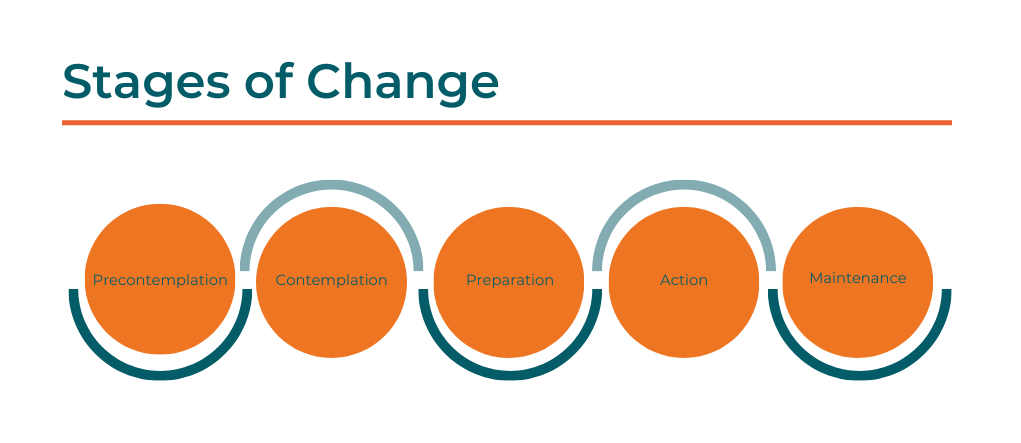
To better understand where your child’s readiness for change is, let us explain the 5 motivational stages of change. In the context of eating disorders in children and youth, a study by Bustin et al. (2013) describes the 5 stages with the following statements:
- Pre-contemplation Stage: “Other people think I have an eating disorder, but I don’t or I don’t want to change”
- Contemplation Stage: “I realize I have an eating disorder, but I’m not sure if I’m ready to change”
- Preparation Stage: “I am planning to take action against the eating disorder in the next few months”
- Action Stage: “I have taken definite actions towards recovery within the past 6 months”
- Maintenance Stage: “I am working to maintain the changes I have made to remain in recovery”
Some articles suggest there is a 6th stage, known as the “Recovery Stage” where one is fully recovered from the eating disorder. We will be focusing on the first 5 stages in today’s post.
Pre-Contemplation
The very first stage of change is known as the pre-contemplation stage. Here, your child may not recognize they have a problem at all, or they may refuse to make changes. The eating disorder brain is calling the shots. This is common. It does not mean that your child cannot have successful recovery. In eating disorder recovery in children and youth, what matters is that the parent is ready for change.
When we approach someone that is in the pre-contemplation stage, we encourage trying our best to stay calm and try to see things from their perspective. Remind them of your compassion and understanding. We also recommend trying to take the focus off of the eating disorder. You can try framing the conversation around their interests and hobbies that may be more difficult now due to the eating disorder.
Contemplation
In the contemplation stage, your child may realize something is wrong and can acknowledge the eating disorder. In this stage your child may be willing to talk about and learn about eating disorder treatment, but they are not quite ready to take action. As we said before, for eating disorder treatment to be successful, what matters most is that the parent is ready to take action and make change.
If this stage sounds familiar, you will also likely recognize that your child’s attitude may fluctuate between being willing to admit there is a problem, to being in denial that change needs to be made. This can lead to feelings of frustration or confusion for both the child and the parent. This is normal. When we are talking to someone in this stage of change, we should try to encourage them to speak about their thoughts, feelings, and concerns. Try saying statements such as “I hear you saying you are frustrated” to demonstrate to your child that you are listening.
Preparation
When your child is in the preparation stage, they are able to decide it is time to make a change. They are also able to take small, actionable steps toward eating disorder recovery. Even more than before, your child may be looking for support from their loved ones during this stage.
This can be a particularly difficult time for an individual living with an eating disorder. A lot of feelings of anxiousness, stress, and discomfort may come up for both the person living with an eating disorder and those around them. A qualified eating disorder expert, such as a team of dietitian nutritionists, therapists, and doctors is often necessary to make the changes necessary for eating disorder recovery successful. If your child is experiencing this stage, you can help by being as well-informed as possible. Try searching for information about what you and your child can expect next in eating disorder recovery.
Action
The action stage is when the child is ready and able to willingly make the changes needed to work towards recovery. In this stage, treatment is already underway. Your child will be learning how to challenge harmful thought patterns and behaviours that enable the eating disorder. They will also be learning new, helpful strategies to cope.
These changes are not easy to make or easy to stick with. At Change Creates Change Eating Disorder Care, we often reflect on how recovery is not a linear journey. What we mean is that it is common for folx living with eating disorders to move up and down through the stages of change. Relapse is sometimes part of recovery, and it does not mean failure.
Supporting your child through the action stage requires a lot of encouragement. We should try to acknowledge how hard we know they are working, and how difficult it is to make these changes toward recovery. Celebrate the victories along the way to develop their confidence that recovery is possible. If relapse does occur, gently remind your child that it is normal and common in eating disorder recovery.
Maintenance
In the maintenance stage of change, your child is able to sustain change for 6 months or longer. Your child is actively practicing their newly learned, positive behaviours and coping skills. In this stage, your child may work with their recovery team to identify possible triggers in order to make a plan and prevent relapse. Your child is learning to live without the eating disorder.
In this stage, it is important to applaud and recognize your child’s hard work toward change. We should try to show our compassion and patience and remind the child that we are working together to fight the eating disorder. Your child’s recovery team will likely have you work with your child to identify possible triggers, and put systems in place to avoid relapse.
Change Creates Change Eating Disorder Care can help you and your child work through the stages of change to reach eating disorder recovery. If you’d like to learn more about how we can help, click below to book a free 15-minute consultation call with us.
*Reserved for Canadian residents.