
We all have ways in which we cope with stress. However, not all coping strategies are created equally. In fact, some of the more common coping skills that are used in folks living with an eating disorder may actually be harmful. These include eating disorder behaviours such as binging, purging, and negative thought patterns.
In eating disorder recovery, there is often a push to adapt more positive ways to cope. In this post, we are going to go over 4 coping skills that you and your child can add to your recovery toolbox.
Watch The Video Series Here
Positive Coping Skills
Studies have shown that young patients diagnosed with eating disorders often have maladaptive coping skills. That means that the coping skills they use may actually cause harm. An example of this engaging in eating disorder behaviours to manage stress. To combat this, folks who are able to bring their awareness to the thoughts and emotions are less likely to engage in eating disorder behaviours.
During eating disorder recovery, your child’s team of experts will encourage them to learn about positive coping strategies. These are tools we can add to our ‘recovery toolbox’ to use when we feel triggered or we are under stress. We are going to go over 4 coping skills that both you and your child can add to your toolboxes today.
1) Square Breathing
The first technique we will talk about is Square Breathing, also known as Box Breathing. It involves taking slow, deep breaths and can help relieve stress. Square breathing has been shown to calm the nervous system, lower blood pressure, and create a sense of calm and relaxation in the body.
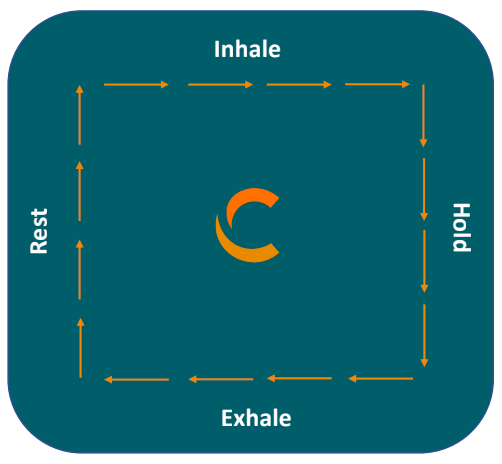
You can sit, lie down, or stand in a comfortable position. If you can, move to a quiet environment where you can focus on your breathing. For all our breaths, we will use a slow count of 4 – that is 1, 2, 3, 4. If you would like, you can visualize a box or find a square or rectangle in your space that you can follow along with. If you choose to use a square or box, we will start at the top left corner and move clockwise.
We inhale across the top of the box for 4 counts, hold the breath down the box for 4 breaths, exhale across the bottom of the box for 4 counts, and hold that for 4 counts as we go up the box.
Steps for Square Breathing
- Breathe in for 4 counts
- Hold the breath at the top for 4 counts
- Breathe out for 4 counts
- Hold the breath at the bottom for 4 counts
- Repeat as necessary
2) Dive Reflex
This tool can be used to quickly calm the body during intense emotional situations. It is based on the body’s natural safety response to being submerged in cold water. This natural response is very quick and almost immediately slows the heart rate and turns on the parts of our nervous system that are responsible for calming us down.
This coping mechanism is unique because the person experiencing the heavy emotions does not need to be an active participant in order for the strategy to work. For this tool, we need something very cold. For example, access to cold water, an ice pack, or a bag of frozen peas. There are a couple ways to use this tool, depending which is accessible in the moment:
- Filling your sink or tub with cold water
- Filling a bowl with cold water or ice
- A bag of cold water or ice cubes
- Ice packs or a cold compress
- Ice cubes
- A frozen or cold water bottle
We want to get the cold item as close to our temples, neck, or head as possible. If that is not accessible or comfortable, placing the cold item on the wrists or in the hands can work as well. Hold the ice or cold item in place for 30 seconds to 2 minutes, but for no longer than 2 minutes at a time.
3) The 54321 Technique
This technique takes a little longer than the others, but is a great tool to bring our minds back to the present moment. This tool involves being mindful of our 5 senses – sight, touch, hear, smell, and taste. First, take a deep breath in.
- Take a look around the room. Name 5 things that you can see.
- Name 4 things that you can physically feel. This could be your feet on the floor, or your arms resting on your lap.
- Name 3 things that you can hear.
- Name 2 things that you can smell.
- Lastly, name 1 thing that you can taste right now.

4) Butterfly Hug
The butterfly hug method is a tool from the EMDR Institute. It is a type of psychotherapy treatment that is often used with people who have experienced trauma. Click here to learn more about EMDR.
To start this technique, interlock your thumbs to create a butterfly shape with your hands. Your palms should be facing your body. Point your fingers as high towards the sky as possible so that your hands are almost vertical. Place your hands on your chest so that your fingers are just underneath your collarbone. If you would like, gently push your hands into your chest to create gentle pressure.
Take a deep breath down to your belly. When you’re ready, begin tapping on your chest with your hands on each side. We will alternate which hand taps, so tap with your left hand, then right hand, and so on. We want to do this for 1-3 minutes. You can close your eyes if you wish, or you can try looking down at your nose.
When you start to find a rhythm, you may notice some thoughts popping up. Try to acknowledge the thoughts without judgment. You can try to envision the thoughts popping up like a cloud and floating on. Or, you could imagine your thoughts on leaves floating down a river and watch as they float to and away from you.
How to Help Your Child with Positive Grounding Tools
It is best to practice using these positive coping skills when your child is feeling neutral.
Interested in learning more about how Change Creates Change Eating Disorder Care can help you and your child navigate recovery? Click the button below to book a free, 15-minute consultation call with us.
*Reserved for Canadian residents.