
Has your child expressed a fear of weight gain? Gaining weight during adolescence is totally normal and very important! It is a natural part of the growth process. Until about 20 years old, children’s weight is meant to increase.
From birth, through childhood and through the teen years your child’s weight is never meant to be less than it was the day before. Unfortunately, this weight gain may trigger eating disorder behaviours in your child, particularly as they are a teenager.
Watch The Video Here!
Why Do Teenagers Need to Gain Weight?
There are many reasons why your child will and/or should continue to gain weight as a teenager. Your child’s body is growing very quickly and they need to gain weight to continue this growth. As well, your child’s bone density is increasing all throughout their teenage years. This means that their bones are still growing to get stronger.
Another reason your child will and/or should gain weight during adolescence is because their muscles are developing. As your child grows and matures, their muscles continue to get larger. Your child’s digestive tract also matures, which requires growth. All of these changes are normal parts of the growth process and they all require that your child is gaining weight and eating enough food. Unfortunately, an intense fear of weight gain may be a red flag of an eating disorder.
Growth Stunting
The term growth stunting means that growth has been impaired, or failure to meet one’s full growth potential, as described by the World Health Organization (WHO). As we mentioned above, your child’s body needs adequate nutrition to grow and develop.
In children or teens living with an eating disorder, growth stunting can be a result of malnutrition. In those living with an eating disorder, this malnutrition can be a result of a fear of weight gain. When this occurs, there are potential negative effects on your child’s health. Specifically, it can have negative impacts on your child’s bone density that may not be reversible. Poor bone density can lead to decreased bone strength and increased risk of bone fractures. Fortunately, when we are able to catch eating disorders quickly and re-nourish the body safely, we may be able to reverse the damage.
Growth Charts
When we talk about what is considered “normal growth”, we use growth charts to compare a child’s weight to their length, height, or age. The World Health Organization created growth charts to monitor the growth of individuals aged 2 to 20 years of age. The charts are divided by sex, so there are different charts for biological females and males. Some types of growth charts include weight-for-length, length/height, weight measurements, and BMI. Plotting only one of your child’s measurements on a growth curve will show you how your child is growing in comparison to other children.
For example, if your child is in the 50th percentile for their weight, this means that 50 percent of children weigh more than your child and 50 percent weight less than your child. Or, if your child is in the 30th percentile, 30 out of 100 children (30%) weigh less than your child, and 70 out of 100 (70%) of children weigh more.
To accurately measure your child’s growth, their growth should be plotted over time to identify trends. Your child should generally remain in a similar percentile throughout their growth. At Change Creates Change Eating Disorder Care, we always say that an adolescent should not weigh less than they did the day before. Below, we included a picture of a WHO growth chart. As you can see, weight is expected to continue to go up and up until around 18-20 years, when it begins to plateau. Until that 18-20 year mark, it is normal to see 5-7 kg (11-15 lbs) of weight gain each and every year.
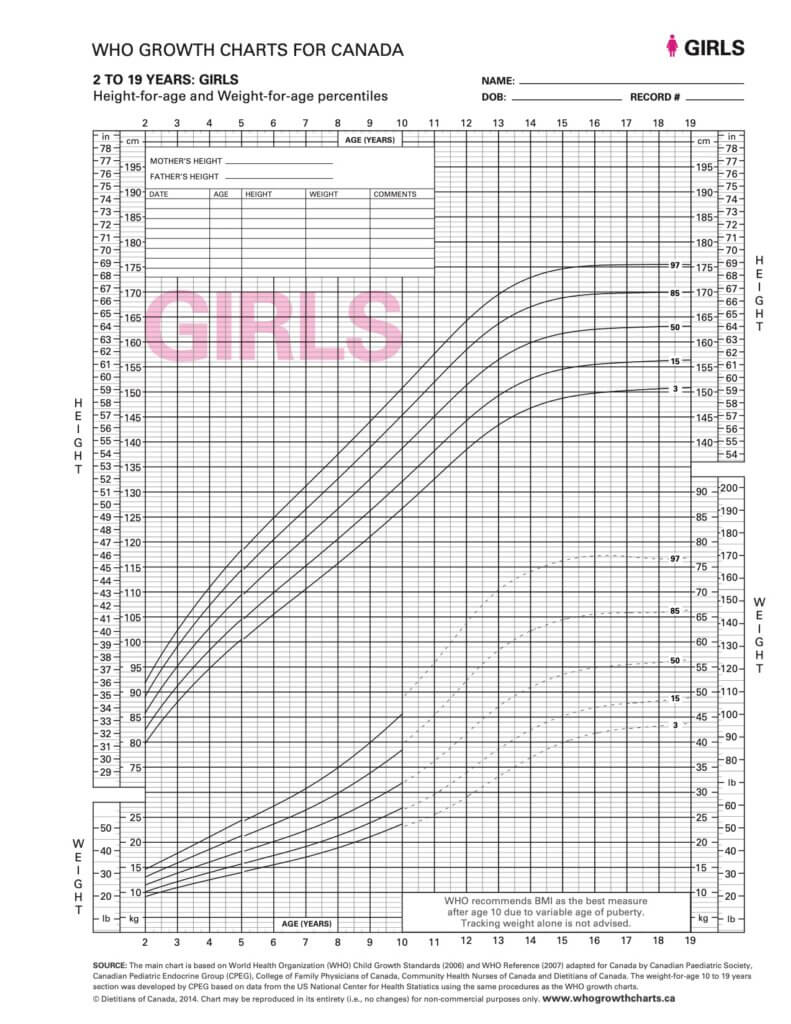
How much should a teenager gain in a year? Here is the expected average weight gain of teenagers by age group:
- 12-13 years of age: 5kg per year
- 13-14 years of age: 5kg per year
- 14-15 years of age: 3kg per year
- 15-16: 1-2kg per year
Doctors and registered dietitian nutritionists are trained to read and interpret growth charts. There are many resources available online if you would like to learn how to read your child’s growth chart.
What is Weight Restoration?
Keep in mind, these 5-7kg per year are for normal weight gain. If your child has been living with an eating disorder, they likely experienced some form of growth stunting. When this is the case, weight restoration is encouraged. Weight restoration is a term that describes when your child goes from their malnourished state to their “normal position” on the growth chart.
Your child’s “normal position” is where they fell on the growth curve before the malnutrition occurred. Every child is unique, so there is not a generic calculation that we can use to determine how much weight would be “normal” for them to achieve restoration. Instead, we use the term “state not weight”. When we say this, we mean that we focus on how your child is feeling, how they are recovering, and the status of their health rather than focusing on a number on a scale.
Using BMI in Children/Teens
In our practice, we often hear of BMI being used when talking about weight in children and teens. Particularly, we hear this a lot in clinical diagnosis of what is considered “underweight”, “normal weight”, and “overweight”.
At Change Creates Change Eating Disorder Care, we are a team of weight-neutral dietitian nutritionists and therapists. That means that our team does not use that sort of terminology in our practice. Nonetheless, it is a term we often hear in the healthcare world. We urge caution when using BMI in children and teens as it was never intended to be used in kids and youth. Instead, we encourage people to turn away from BMI and use growth curves instead. This means that rather than looking just at weight alone, we look at the velocity and trajectory of growth between birth and 19 years of age.
If this brings up questions or you would like to find out more, you can click the button below to book a free consultation call with us. If your child shows signs of a fear of weight gain, know that you are not alone and we are here to support you.
*Reserved for Canadian residents.